Wrangell - St Elias National Park & Preserve
Wrangell-St. Elias is a vast national park that rises from the ocean all the way up to 18,008 ft. At 13.2 million acres, the park is the same size as Yellowstone National Park, Yosemite National Park, and Switzerland combined! Within this wild landscape, people continue to live off the land as they have done for centuries. This rugged, beautiful land is filled with opportunities for adventure.
Map showing location of park.
Wrangell-St. Elias Subsistence Resource Commission to Meet Oct. 9-10 in McCarthy
The Wrangell-St. Elias National Park Subsistence Resource Commission will meet Oct. 9-10 at the Great St. Elias Station in McCarthy, with options to participate virtually or by phone. The McCarthy meeting location is a change from the location published in the Federal Register due to venue availability.
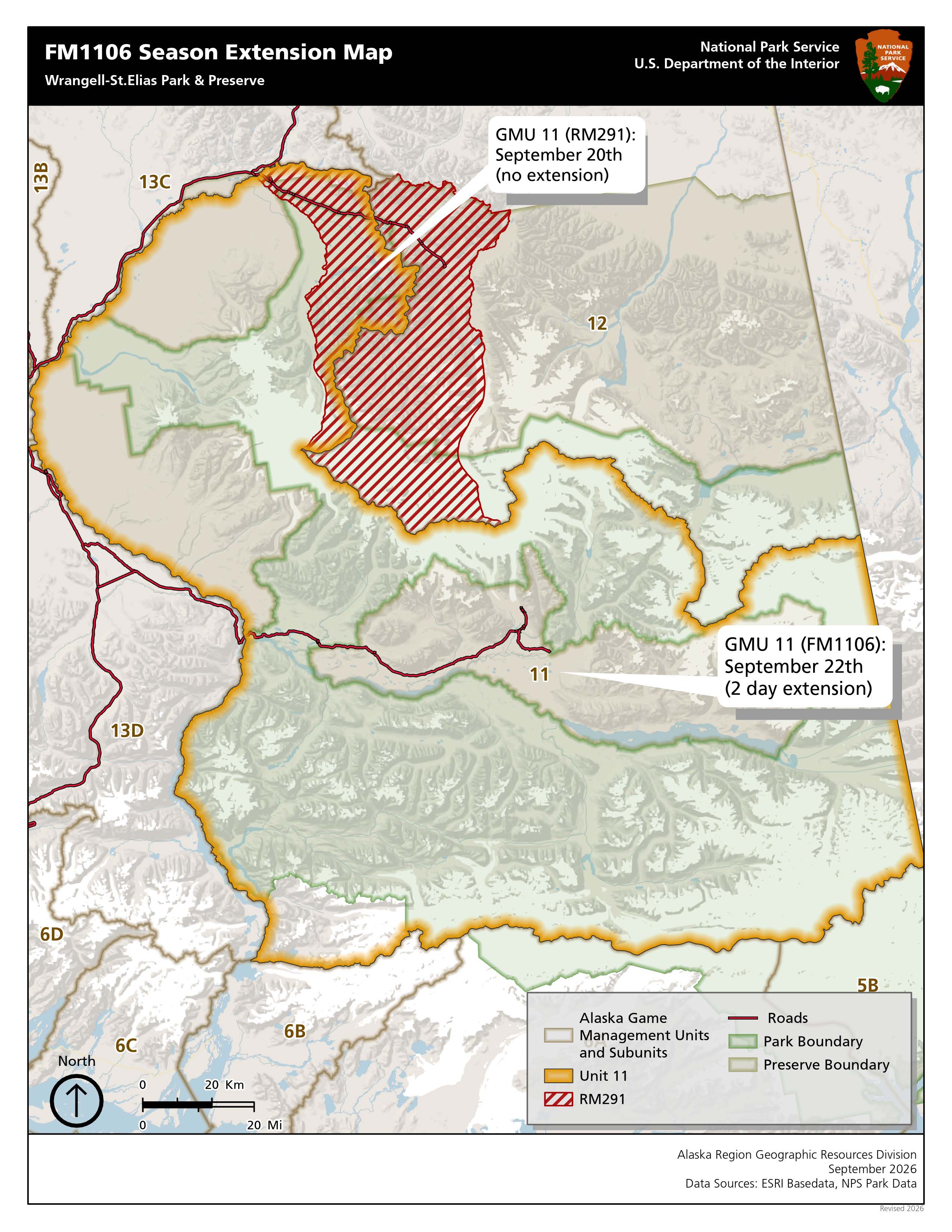
Two-Day Moose Hunt Extension Applies Only to FM1106
Wrangell-St. Elias National Park and Preserve is reminding federal subsistence hunters that the additional two-day moose hunting season in Unit 11 applies only to the FM1106 hunt area. The FM1106 season will reopen at 12:01 a.m. Monday, Sept. 21, and close at 11:59 p.m. Tuesday, Sept. 22, 2026.
Federal Subsistence Moose Hunt Opened for Two Additional Days in FM1106 Hunt Area
Wrangell-St. Elias National Park and Preserve Acting Superintendent Joshua Scott, under authority delegated by the Federal Subsistence Board, is opening a two-day moose hunting season in the Unit 11 federal registration permit hunt area (FM1106). The season will open at 12:01 a.m. on Monday, September 21 and close at 11:59 p.m. on Tuesday, September 22, 2026, unless modified by a subsequent federal special action.
Helicopter Operations to Support Stabilization Project at Erie Mine Bunkhouse
Wrangell-St. Elias National Park and Preserve will use a helicopter in mid-September to support a stabilization project at the historic Erie Mine Bunkhouse. The helicopter will transport personnel, equipment and materials between McCarthy and the remote historic site. Flight dates will depend on weather and conditions.
Wrangell-St. Elias Seeks Public Comment on Proposed Changes to Electric Bike Use
Wrangell-St. Elias National Park and Preserve is seeking public comment on a proposed change to the Superintendent’s Compendium that would modify the use of electric bicycles in the park. The proposed update would make the park’s management of e-bikes consistent with other forms of transportation used to get to Kennecott Mines National Historic Landmark. The change would permit e-bike riders to leave bikes at the Shuttle Bus Turnaround just south of the Kennecott Visitor Center (where ATVs, personal vehicles, and bicycles are already allowed to park).
Photo by NPS Photo/ Neal Herbert
Photo by NPS Photo/ Bryan Petrtyl
Photo by NPS Photo/ Matthew Yarbrough
Photo by NPS Photo/ Bryan Petrtyl
Photo by NPS Photo/ Bryan Petrtyl
Photo by National Park Service
Photo by National Park Service
Photo by National Park Service
Photo by National Park Service
Photo by National Park Service